| New Year in Cartagena | |||||||||||||||||||||||
The year is starting out very differently for me. A mix of Peace Corp policies, holiday travel price spikes and family interests delayed Donna’s travel to Colombia to a bargain flight on Spirit Airlines on January 1, 2016. We hemmed and hawed, but eventually bought the ticket which had a face value of just $70. The cost about doubled because of their spirited baggage fees, but this was still less than 1/3 the ticket price leading up to Christmas. Colombians are very family oriented, and I think that the demand for flights into Colombia is very high before the holiday and now the return flight is very high following the holiday. I planned to catch an early bus to Cartagena (five hours) on January 1, meet Donna’s flight at 1:30 PM then either hop another bus right back or stay one night. I didn’t realized that the buses I am supposed to use don’t operate on January 1. This ruled out going either direction that day. I then planned to take the bus on January 31st, early, to Cartagena and spend the balance of the day prowling around the historic district, stay overnight in a hostal, meet the flight on 1/1/16, spend the rest of the day with Donna walking about the old city and depart the following day to Aracataca. That’s mostly how things went. Details follow. Wednesday, 12/30/15 A day like most others. I worked at the Alcaldia and watched more of my colleagues pack their bags for the last time. The change of Mayor (Alcalde) and Council (Concejo) on January 1st ushers in a new cabinet heading departments like public health, planning and finance, but apparently triggers changes down another wrung in the ladder. Many of the people leaving were only asked to resign in the final days, so they had little warning. A friendly young lawyer that sat next to me worked until the final hour, after many had left, then packed up and said he was asked to resign and goodbye. I admire the dedication of employees willing to work under these conditions and willing to depart with a simple goodbye and an optimistic hope that another door will open while this one closes. He and I had several interesting conversations during the time we worked together. As in the US, people here are free to shop around for church and religion, looking for the right mix That evening the string of holiday visitors to the house continued. At about 9:00 PM amidst waves of visitors, the newly elected mayor of the neighboring town of Reten dropped in with a small group of his friends. Manuel scrambled for the obligatory bottle of Old Parr Scotch Whiskey. The night before my trip to Cartagena to meet Donna's flight a bunch of people arrived at Manuel and Rosa's home. They included the new mayor of Reten and his entourage Manuel's nephew an anesthesiologist with his family, and we several sisters on both sides of the family. Manuel uncorked a new bottle of Old Parr (Scotch blend made in Scotland for export to Japan and South American markets.) I don’t drink and haven’t for about 30 years, but I’d be remiss not to include some brand marketing. I’m most aware of three classes of drinking in Aracataca. Old Parr is the liquor of choice among people of means. The bottles have a glass marble built into the neck that slow pouring, so that the server can move around the room filling a shot class or small plastic cup from which everyone drinks one-at-a-time amidst a great deal of toasts and humor. Old Parr Scotch retails for about $90.000 or $30.00 US for .75 liters which would be a fifth, give or take. That’s a hefty sum of money in this country. The official minimum wage in Colombia is $644.350 per month (US $200), so a bottle of Scotch would be several days wages. Many Colombians make far less than the minimum wage. As the Colombian peso declines, the cost of imported goods like Scotch will go out of reach for all but the wealthiest families.
Among the bargain drinkers, the beverage of choice is Aguardiente, which is a strong, clear rum. The price is about $36.000 per liter (quart) or $11.00 US. Most people buy smaller 1/3 liter bottles that would be roughly 24oz for about $4.00 US, still a substantial sum. In Ecuador I tried the aguardiente a found the flavor to be very different from rum in the US. I didn’t care for it at all. People also drink beer, usually from their own bottle or glass, though I think there is some level of passing around the glass as well. A bottle of beer retails for about $2.000 pesos or 75 cents. It is not uncommon for people at a party to have their own bottle of beer, but also accepting toasts of rum or whiskey. It turned out that the mayor’s brother and a colleague were driving to Cartagena the next morning. They kept changing their minds about what time they would leave 4:00 AM, 5:00 AM, 6:00 AM. 12/31/15 I assumed that they would be late, given the hour and their many toasts, but in this case they were very punctual. They arrived at 5:00 AM in a nearly new club-car pickup truck with vallenatos on the stereo and air conditioning blasting away. I joined them for a four and a half hour race through traffic on two lane roads. They made great time, but I’d have settled for a slower more tranquil journey. There is a lot of rural, curbside development along this primary highway connecting the coast with the more populous interior. A new four lane highway is planned, which may be very dangerous if they do not restrict access to the highway or at least create a small buffer between houses, businesses and traffic. We interrupted the frantic pace twice, once to purchase gasoline and once to eat arepas con huevos, a sort of fried egg sandwich. I was in the back seat and unable to communicate very much, but the scenery was interesting as it altered between palm oil, bananas, the great Sienega (swamp/impounded brackish wetland), and lots of semi-arid grazing land.
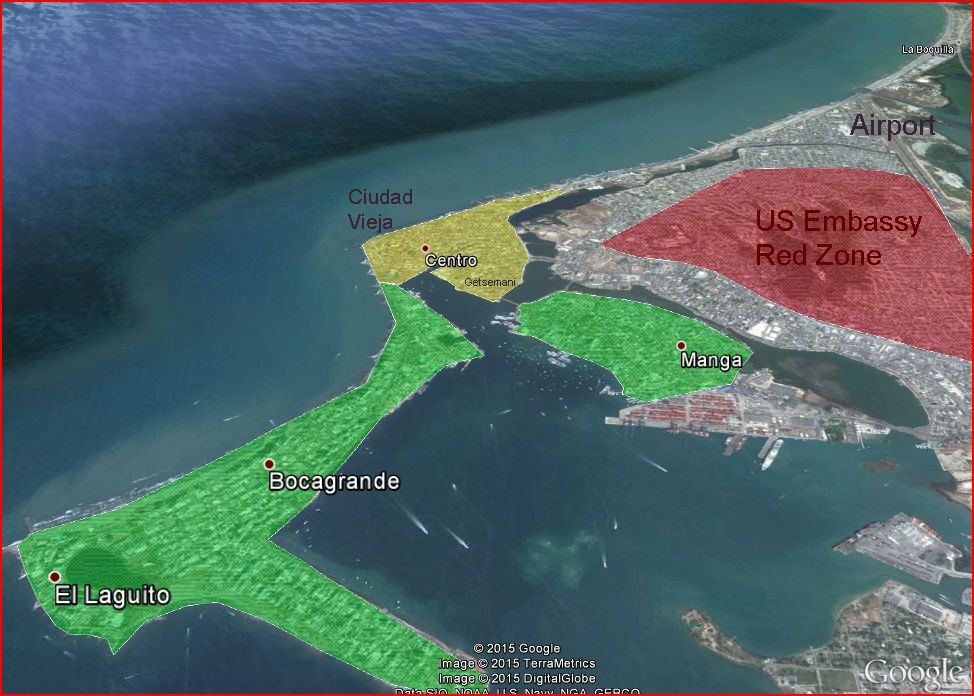
The trip worked out well. I walked from their destination, an upscale condominium complex along the shore road in Boca Grande, to the old city to the walled, historic old city of Cartagena. The walled city is one of the top destinations in Colombia and a great place to wander without any program. It is heavily touristed, which even after just two months without seeing foreigners, was intriguing. Tourists came in three levels, I think. They very high end with 4 and 5 star hotels and exclusive tours, the medium to high end tourists in historic hotels with guided tours and the crowd I normally join, the low end backpackers in dormitory style hostels. I wandered right through the historic city to Getsemani, an area bordering the walled city that is full of hostels offering relatively low cost housing. I was warned that finding a bed would be difficult and that turned out to be sage. I had to hop from one hostal to another in Getsemani looking for a room. All of them were totally booked. A few thought they could find a bed ($30.000 or $10), but could not. I was offered one windowless closet with two beds for $200.000 / $66US) which I turned down. After more than a dozen places, I came to the Tree House Hostel and found a bed for $50.000 or $16), I readily agreed. I liked the atmosphere of young European backpackers, but many of them smoked cigarettes, something I haven’t had to deal with in decades. Colombians rarely smoke, so it was a surprise to find the Europeans to be such heavy smokers. The smoke made hanging out in the common area pretty unpleasant. On a positive note, recyling bins and trash bins are everywhere and encourage people to break the littering habit that prevails in coastal Colombia.
I walked a lot more in the old city along the shore about 5 miles to the airport just to see if it was possible. Peace Corps restricts where we are permitted to travel in Cartagena and how we can travel. We are not permitted to leave the more tourist-friendly coastal part of the city. We are not permitted to ride intra-city buses, and we are not permitted on any buses at night. We can walk locally, ride taxis and use designated inter-city buses or fly. As an urban planner I love to walk across cities, a kind of geographic transect that helps me to think about the physical, economic, social, political and historic forces that shape the built environment. My costal walk was less of a transect than a circumference, but it showed some variation and a high level of public investment to create new visitor facilities, better transportation networks and improved public health. Leaving the walled city, things open up a great deal. The Via Del Mar, or coastal highway runs between the beach and the built up city. Having a highway next to the shore has retained some public space, but some of the highway is washed by breakers coming over the rock walls and access to the shore means crossing a busy highway. The beaches were much cleaner than I have seen in other places. Small businesses rent open-ended tents to families seeking a little relief from the sun. Kids and parents played in the surf, vendors sold mangos, coconuts, sunglasses, shish kabobs, and other fast foods. Some sections of beach also had persons renting jet skis. The designated beaches also have well equipped lifeguards. For such a large city and nice beaches, the number of people swimming was pretty low.
The route sometimes allowed me to walk on beaches, but where there are no beaches, there are major shorefront projects. There is a big effort to create a linear park along one section of shore front. Cement and gravel walkways have been installed, but additional drainage and utilities work is needed. Trees are planted and landscaping is progressing, but for now there is no escaping the sun. It looks like the area will be good for walking, bicycles, public arts and small retail. A large part of it has been built on a deck over the Vial del Mar highway which dips underground long enough to provide easy pedestrian access to the beach and park areas.
There is a short intercoastal waterway built between the old city and the airport. There are a series of auto and pedestrian bridges crossing the canal. My favorite comes down in the Parque Cangrejo Azul, or Blue Crab Park (an I thought Cangrejo was kangaroo). With the 90+ degree temperatures and full sun, it was nice to reach one park that was old, established and shady. From the park I walked along some local roads and right into the airport which is built into a suburban neighborhood. The beaches and beach side parks continue past the airport and beyond my walk. Some of these beaches are being renovated with additional jetties, sand and perhaps some biological work. It’s a big public works effort that I think will be a popular area for residents and tourists by next year. The airport is pretty active with flights arriving or departing about every 30 minutes. By some machination of hubs and spokes, flights between Fort Lauderdale and Cartagena are a bargain, or at least some of them are.Other flights were arriving from New York, Bogota and other Colombian cities. I hopped a cab back to the hostel for about $3 US, not much given our exchange rate. Last year it would have been $5 US. I spent much the evening talking with the hostel owner, who like many business owners hales from the sierra (Bogota). In Aracataca virtually all of the businesses are owned by people from Cali, Medellin, Bogota, Bucaramanga and other interior cities. Native “Costeños” don’t go into business much or only on a very small scale. I don’t understand how the interior and costal cultures differ and why costeños don’t go into business. Costeños call people from some sierra cities “Cachacos”, a somewhat derogatory name for people overly dedicated to profit. The generous disposition of costeños may work against the needs to make businesses profitable, but that is only a guess. I also attended an evening mass (misa) at the Parroquia Santisima Trinidad. I drawn in by a remarkable pianist / vocalist as he warmed up the keyboard and his remarkable voice. The Priest was also warming up his very impressive singing voice. The service didn’t begin for a half-hour, but I stayed, thought about what has been and what is about to change, watched others arrive. The service was more musical, lyrical, and moving that most that I have seen in Colombia. The large, stone church reverberated a great deal, so the priest compensated by pausing a great deal between words and sentences and lapsed into song his sermon. I couldn’t cut through the reverberated sound very well, but I was still impressed by the emotion and feeling that this priest conveyed. After another half hour or so the communion began and as rank upon rank of people lined up for communion I slipped out and walked back to the hostel. 1/1/16 Happy New Year. I was up pretty early. A lot of people were up early, but they had never gone to bed. I walked about for a while and started the trek to the airport much too early. I tried a different route, but it wasn’t as interesting and there were many people out drinking since the night before. I dodged around the parties, sat on the beach thinking deep thoughts, bought coffee, delayed in every way possible, but in the end arrived at the airport much too early and the flight was delayed. It was a slow haul waiting for Donna’s flight, but I found a plug on the floor and whiled away some time composing on my phone and waiting.
The flight arrived, Donna came through immigration unscathed and all is well in the world. She had two big packs so walking wasn’t in the cards. We took a cab back to the hotel, dropped her bags and spent the rest of the day walking in the historic city and looking for exotic foods like unsweetened yogurt and skim milk (for Donna). We walked into the evening, sat in magical little parks, passed by a group of musicians playing vallenatos with a lot of singing onlookers. We caught up on two months apart, looked over the walls of the city, peaked in hotels that we couldn’t afford, bought arepas (for me), and retired relatively early. New Year is much like Christmas and the Day of the Immaculate Conception. The action takes place overnight before the actual date. Many people that have been up all night must sleep much of the actual holiday. Many shops were closed New Year’s day, but enough were open to manage all of our business. 1/2/16 Before leaving Cartagena we took one last walk in the old city, the marina, a few neat little pocket parks, and quite unexpectedly right into our street in Getsemani. The marina area was more interesting than I had anticipated. It includes two large performing arts buildings, parks, neighborhoods with street-art sculptures and nice little houses.
We packed our bags and caught a taxi to the bus station. Like Barranquilla, the bus station is located miles outside the center of Cartagena. We had only walked in a thin strip along the coast that is considered safe for tourists. The two east west highways that access Cartagena are the Via Del Mar along the coast and another interior east-west highway that enters closer to the bus station. The city continues to sprawl south and the bus terminal is no longer on the outskirts, but in a band of congested urban development. We took a bus from Cartagena to Barranquilla (2½ hours – movie about a group of kids learning to be competitive in karate) and thence to Aracataca. Barranquilla was a zoo with many travelers like us trying to get home after the New Year holiday. After some confusion, we got to a bus for the final 2½ ride. This bus showed a goofball comedy as well. It was nice not to have the super violent films that were on my previous bus ride. So, the cheap flight from Fort Lauderdale to Cartagena took 3½ hours plus a 20 minute drive. The three day ground trip from Aracataca to Cartagena and back included two 5+ hour road trips, to nights in a back-packer hostel, lots of walking and some interesting experiences. Getting there is half the fun. |
 to suit their needs. He was raised Catholic, but had joined one of a burgeoning number of evangelical churches in Santa Marta called Cristianos GNG – sort of a “New Generation” group. I found them on the internet. Thought it says congregational, I'd say they are evangelical and partly the product of one enterprising American evangelist named Roddie Kyle Nelson. It is a curiousity how a evangelical leader in the US finds himself with a following in Santa Marta, Colombia. I suppose he must speak Spanshi. The lawyers efforts to describe his faith to me were no more successful than my efforts to describe Unitarian Universalism to him. The concept of a covenantal faith is pretty hard for me to explain in Spanish, and I guess the concept of a fundamentalist creedal faith is hard for me to embrace. There were many nice people in the office that left in the final days, and I expect the next group will be equally nice, and equally grateful to have a job during this four year administration.